
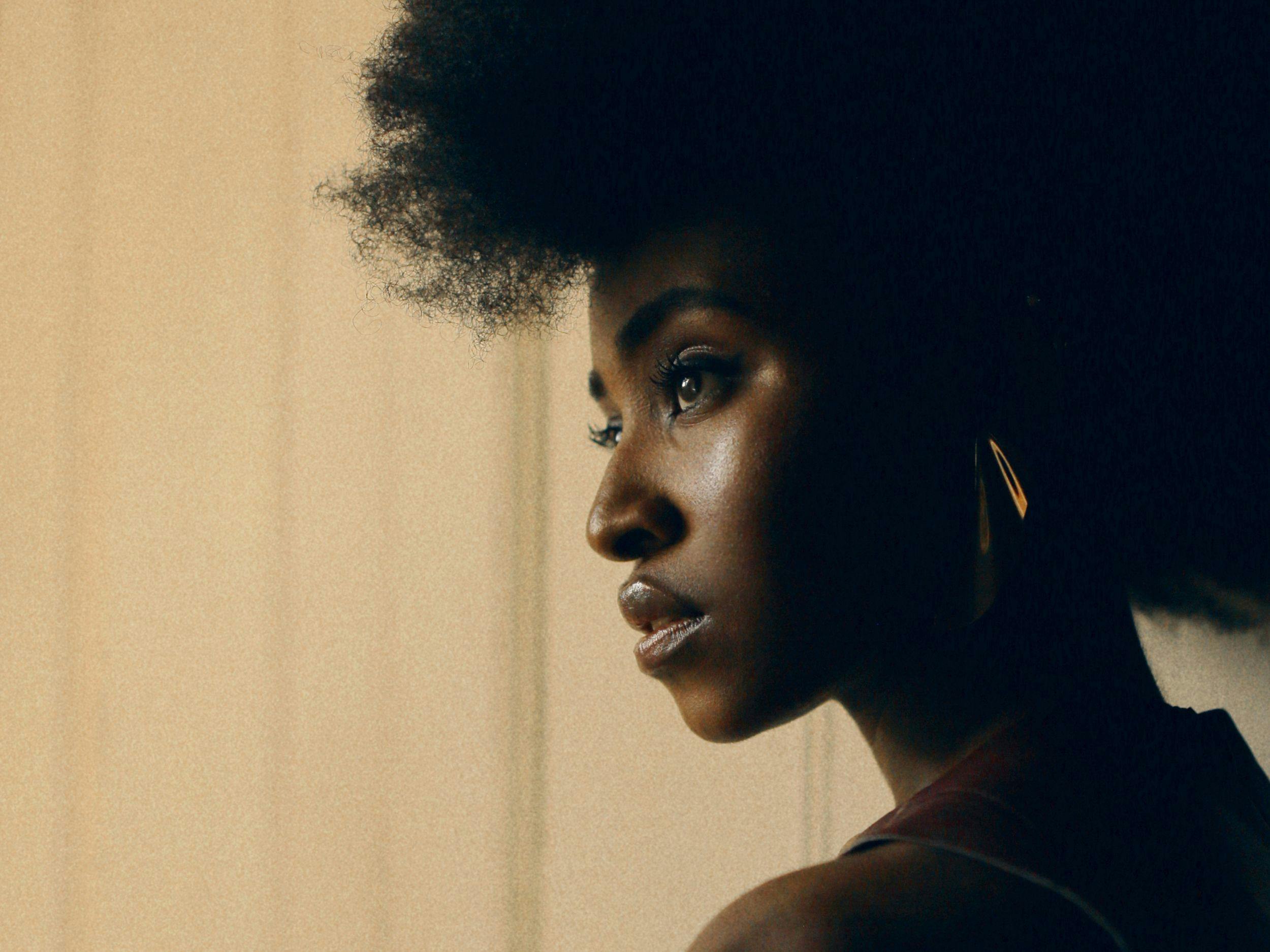
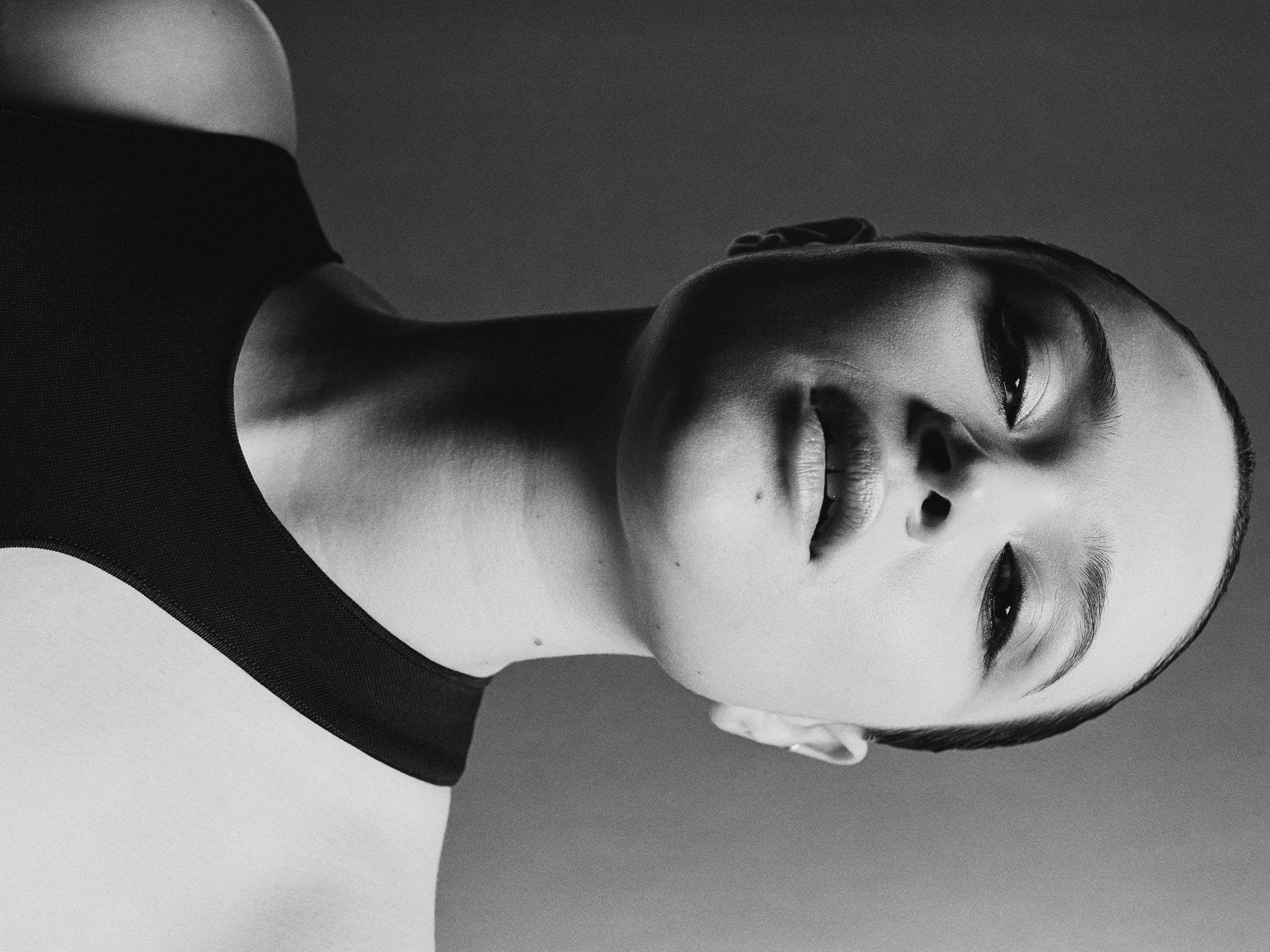
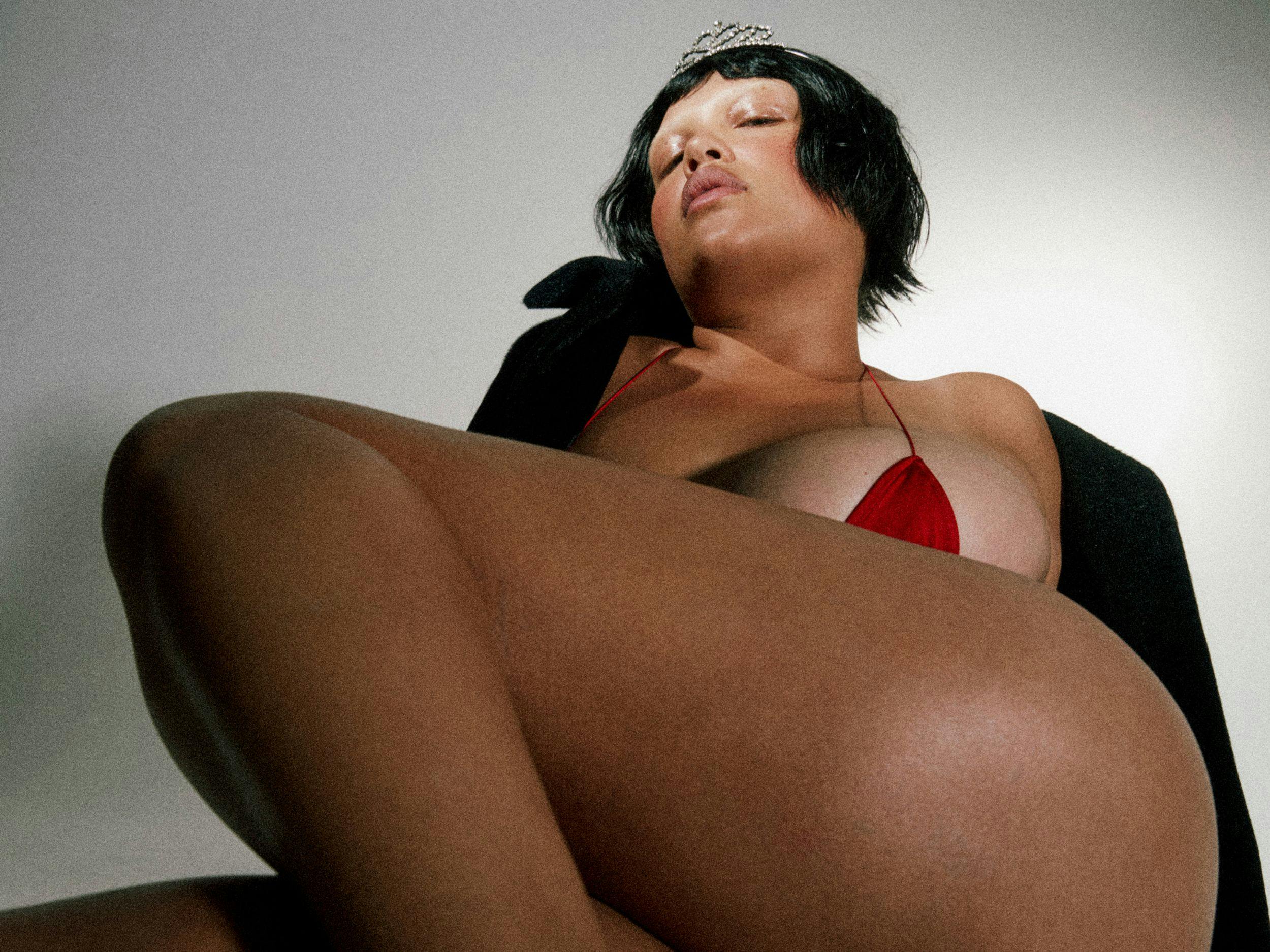
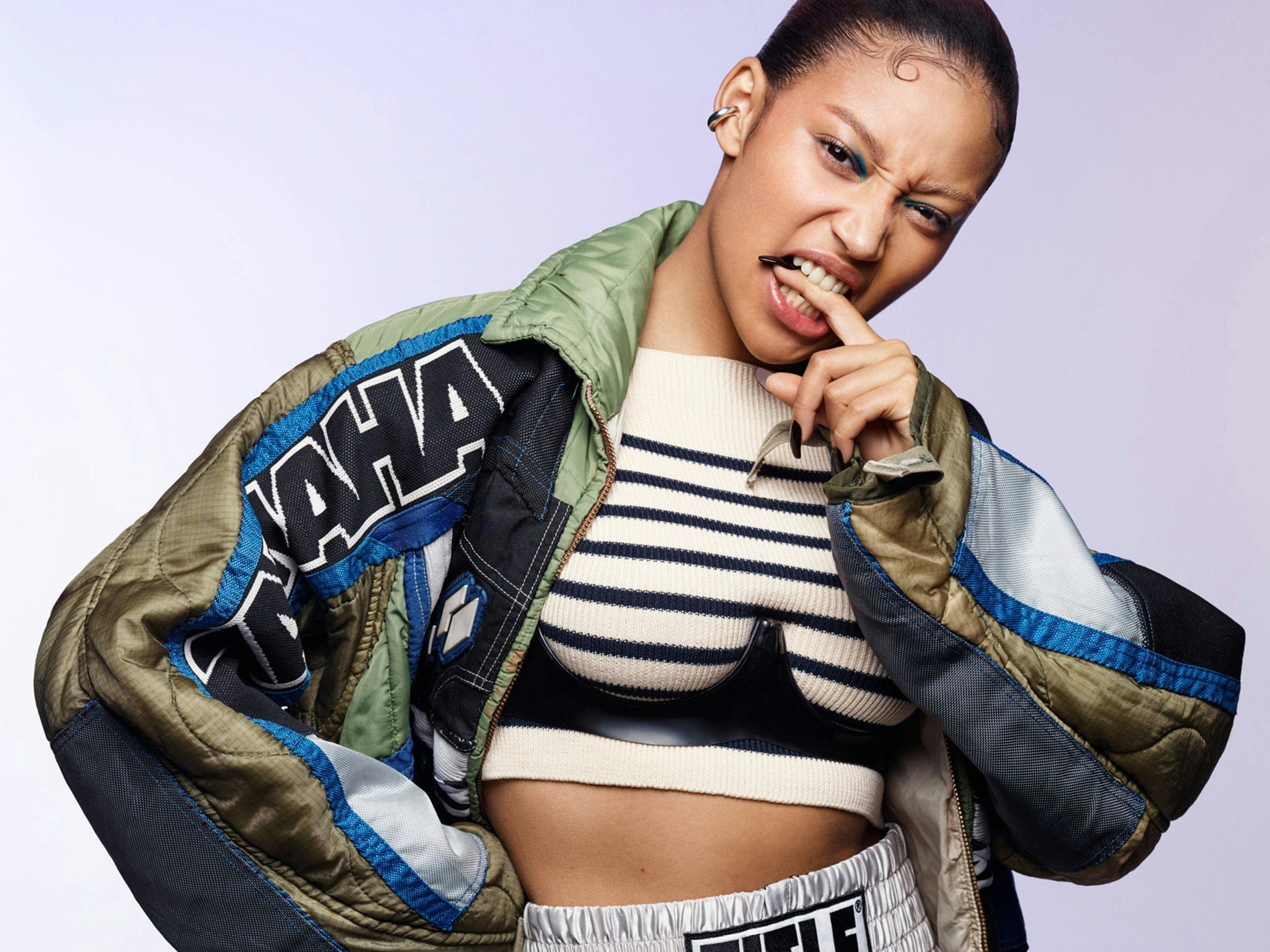
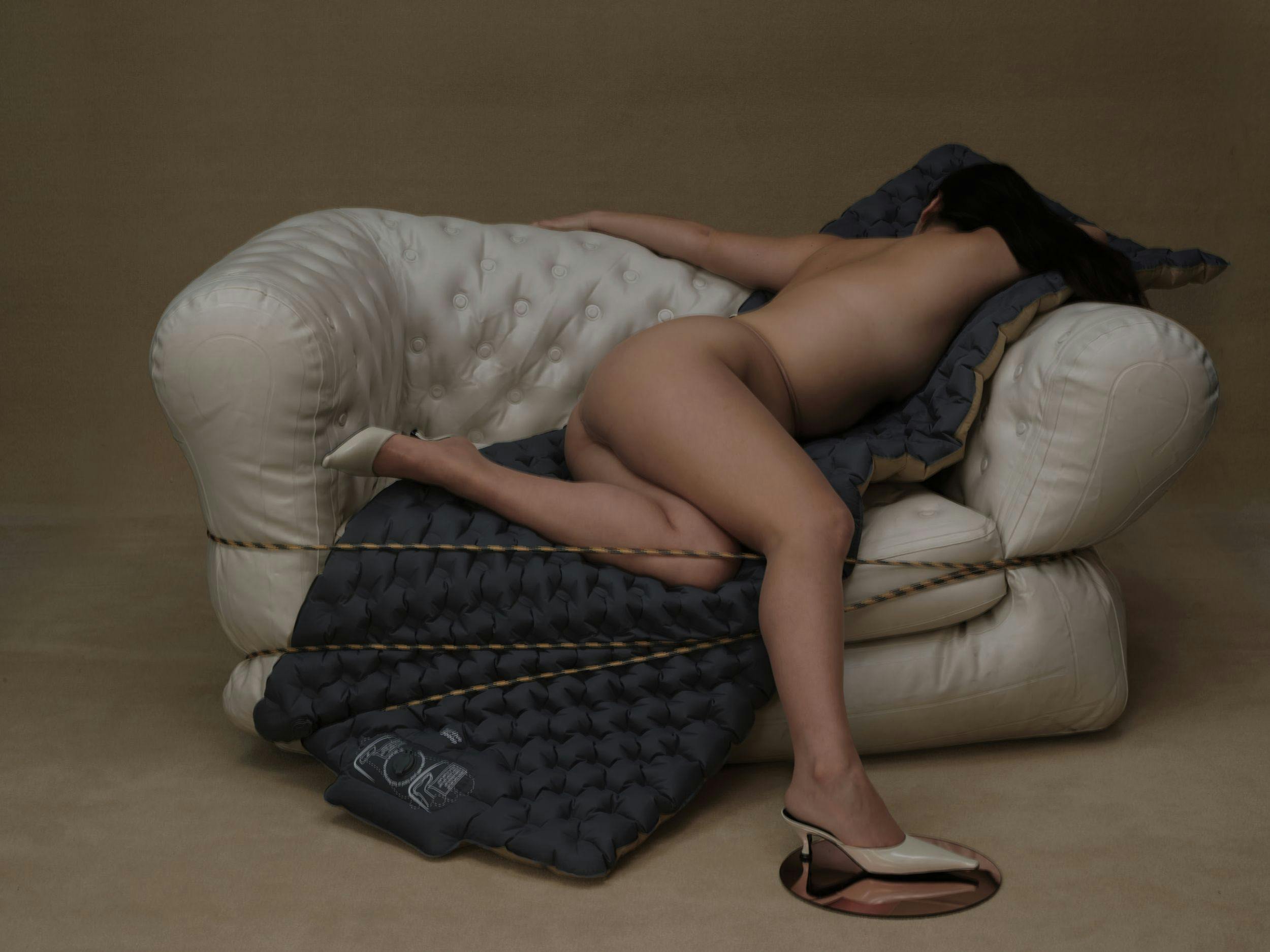
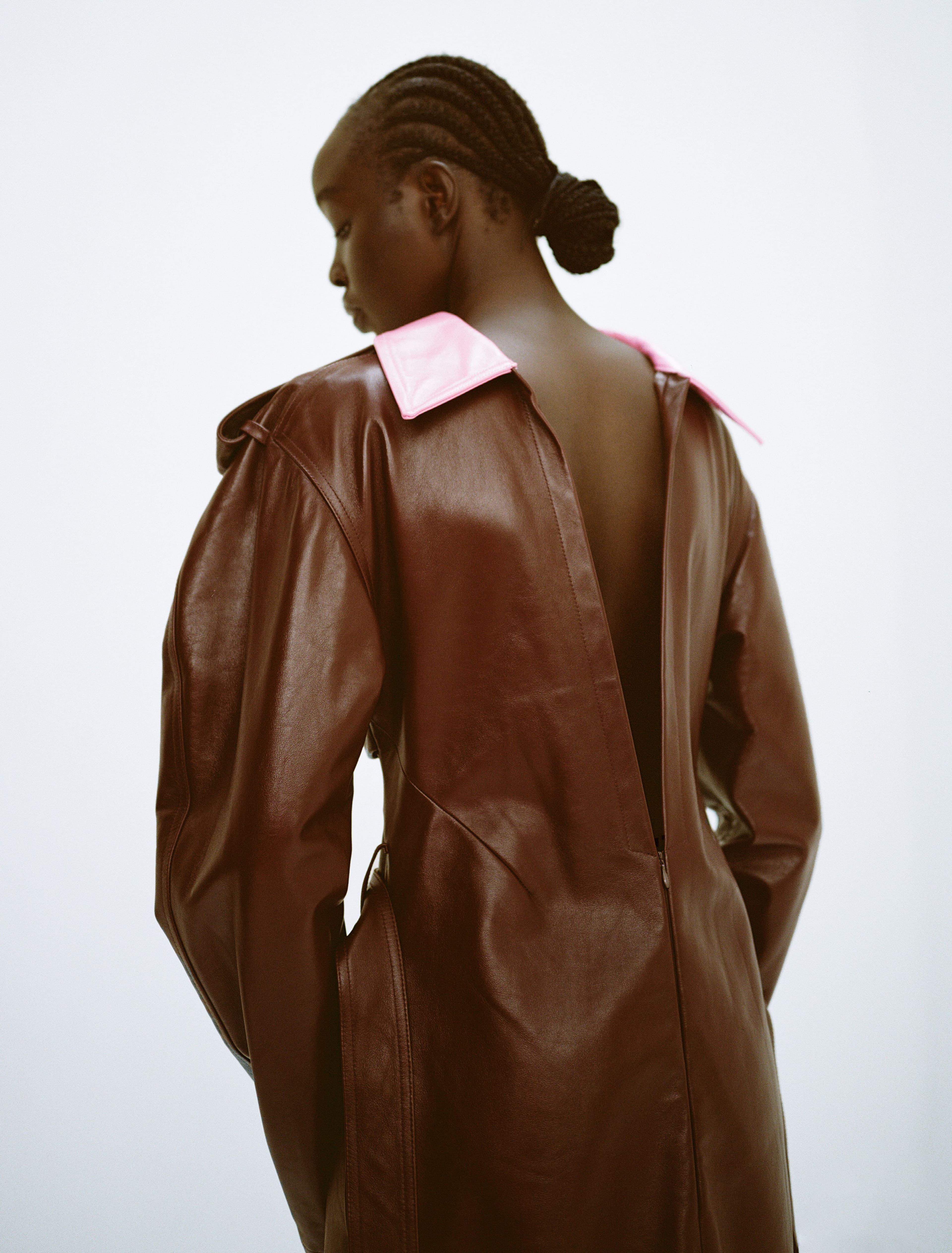
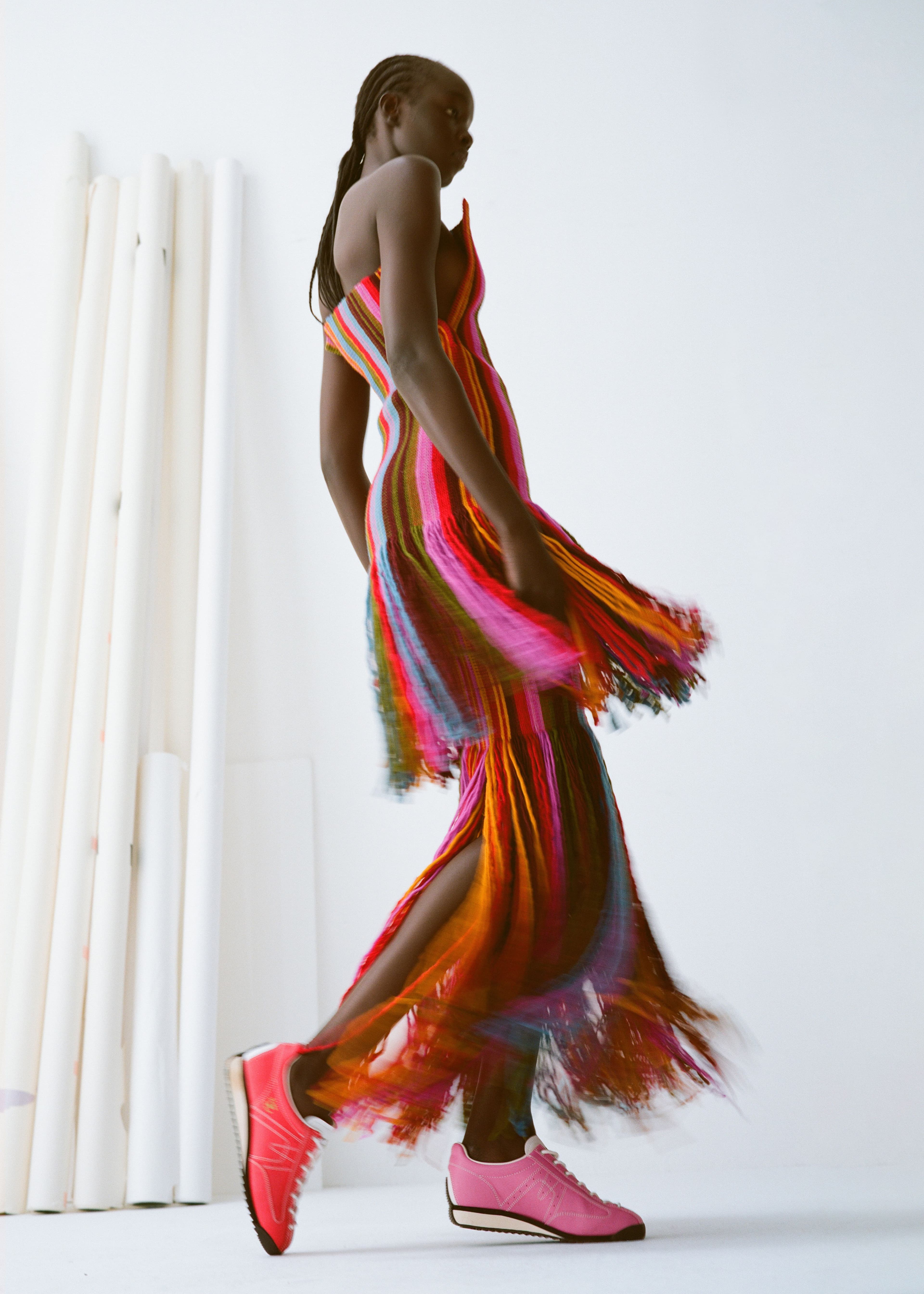
All CLOTHING throughout by Zomer; all SHOES throughout by KARHU by Zomer
The 2025 LVMH Prize: Zomer
In fashion, joy can feel almost rebellious. At a moment when so many collections oscillate between minimalism and melancholy, and in a time wrought with global anxiety, Zomer has emerged as a kind of counterpoint—a brand insisting on pleasure, color, and play. Founded in 2023 by designer Danial Aitouganov and stylist Imruh Asha, Zomer—Dutch for ‘summer’—operates from Paris with the unabashed audacity to revel in optimism and the possibilities of presentation.
The label’s clothes are, put simply, exuberant: color-blocked tailoring, sculptural skirts, garments twisted, flipped, or remixed mid-thought. Below the surface, whimsy lies a deliberate structure, born of experience at major fashion houses and refined through instinctual recreation. Aitouganov—formerly of Chloé, Burberry, and Louis Vuitton—and Asha—Dazed’s fashion director and renowned stylist with clients ranging from Hermès and Moncler to Rimowa and Gucci Beauty—intimately understand the forms and structures of fashion design; they know the rules well enough to break them gracefully. Their partnership is equal parts design and dialogue, and their creative process feels closer to improvisation than to corporate fashion’s rigid rhythms. “If you give a pen and paper to a kid, they just start drawing,” Aitouganov observes. “We like to also start creating like that.”
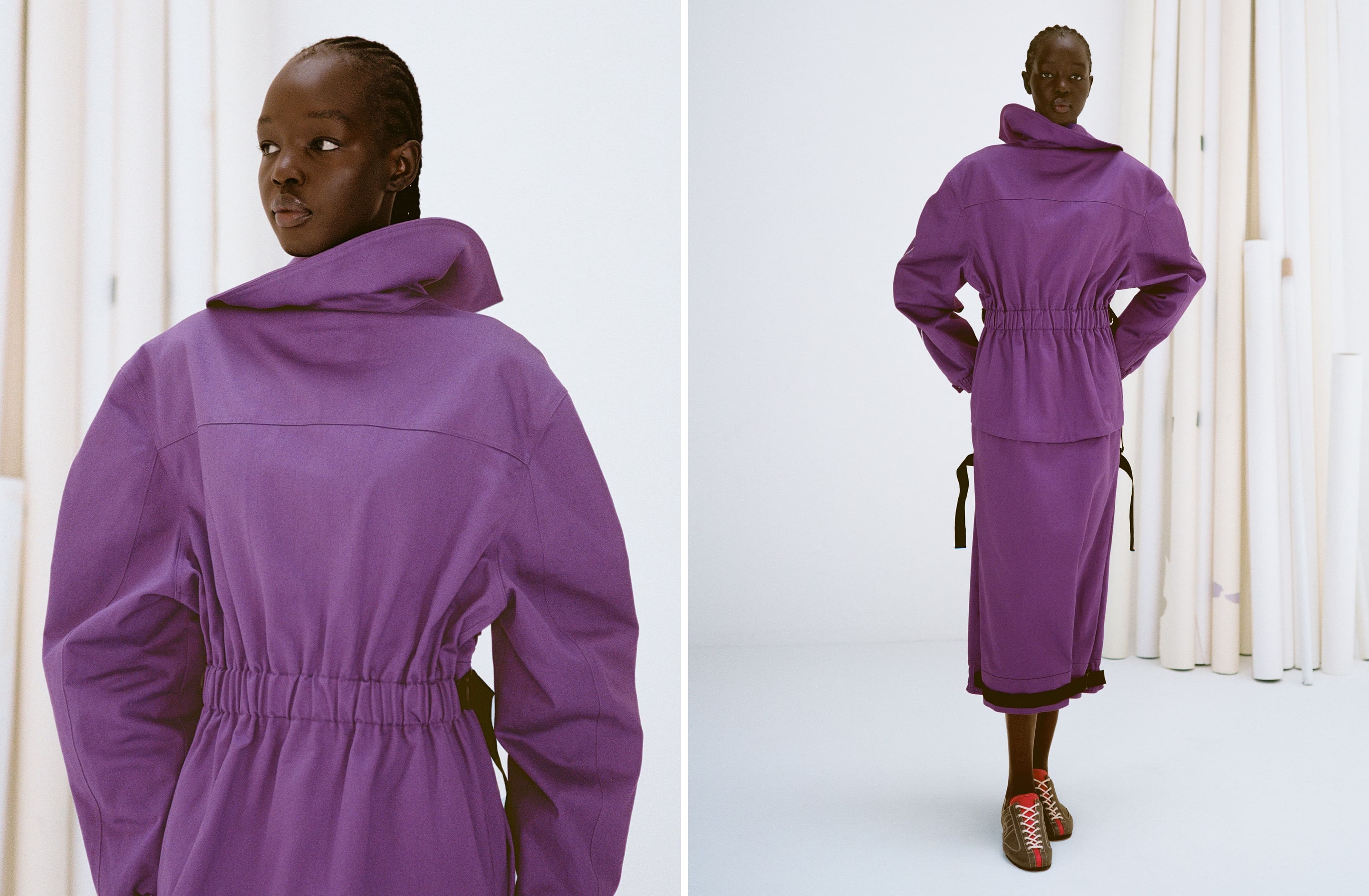
Their instinctive, childlike insistence on freedom has become the heart of Zomer’s æsthetic. Days in the studio begin not with a mood board but with play: trying things on, mixing fabrics, cutting shapes, seeing what feels right. “We just play around with clothing, as dress-up basically,” Aitouganov explains. “We see if we can find some sort of element that is fun that we can repeat.” Such spontaneity gives their collections a lightness—an unstudied ease that’s rare in an industry where every gesture can feel calculated. A curious, confident wardrobe results—the garments are imbued with an experimental touch which elicits a sense of joy.
In spite of all its exuberance, Zomer is grounded in pragmatism. “Design is basically twenty percent of the business,” Aitouganov admits. “The rest is marketing, production, finance.” Two years into its life, the brand remains small, running largely on the labor of a tight-knit team. Growth has been steady rather than explosive: six retailers in its first season, twelve the next, approximately twenty-four today. “[The brand is] not skyrocketing,” he ponders, “but I think that’s healthier because we could not afford to skyrocket—we would kill ourselves.” That deliberate pace, in his view, is essential to survival. “Our first goal is to be healthy as a company,” he declares passionately. “[We want] to pay everyone properly.”
Experience informs their focused philosophy of sustainability; Aitouganov’s years working for established luxury houses exposed him to a culture accustomed to and largely unbothered by burnout. Zomer was conceived, in part, as an antithesis to that pervasive mentality. “It’s a culture that I infused into Zomer. I expect my team to stay longer than seven if they want to, but I’ll never say they have to,” he asserts from his office in Paris. His voice carries the steady conviction of someone who has seen how unsustainable fashion can be—and who understands dated structures can (and ought to be) challenged for a brand conceived post-COVID and in an age of strengthening mental health initiatives.
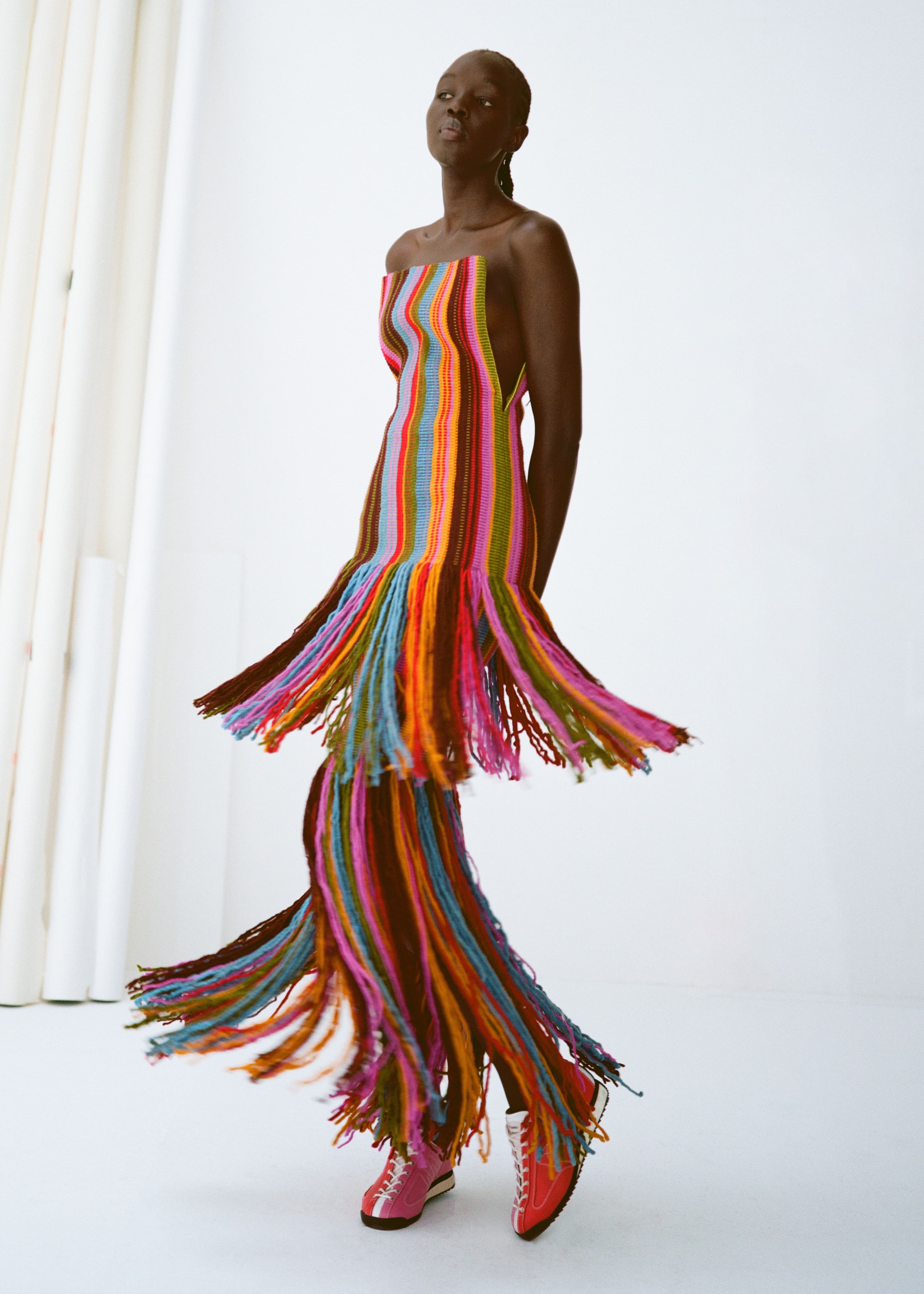
The industry at large has been quick to take notice. Outside of their finalist status for the prestigious LVMH Prize, the duo also advanced to the finalist round for ANDAM’s 2025 Fashion Award. The accolades may have garnered global attention, but Aitouganov insists the infusion of prestige didn’t alter the brand’s course. “It was super cool to be nominated,” he smiles, “but it didn’t really have an impact on our business. Of course, you get more exposure, so that’s good, but that’s it.” For now, Zomer’s focus remains internal: refining operations, solidifying production, and ensuring the creative core stays intact.
Creatively, the duo builds collections through conversation and intuition. Their critically lauded Fall 2025 collection began with a fleeting personal thought. “I was walking around and had quite a personal issue,” Aitouganov recalls. “I was on the phone with Imruh and said, ‘I wish I could go back in time.’ And he said, ‘Why don’t we do a collection going back in time?’” From there, they explored ideas of reversal—garments turned inside out or worn back to front, silhouettes that felt slightly off-kilter. “Some were styled like that for the runway,” he said. “Some were really designed back to front.” The collection’s play with inversion—its deliberate wrongness—became a metaphor for introspection, for the desire to rewind and reimagine.
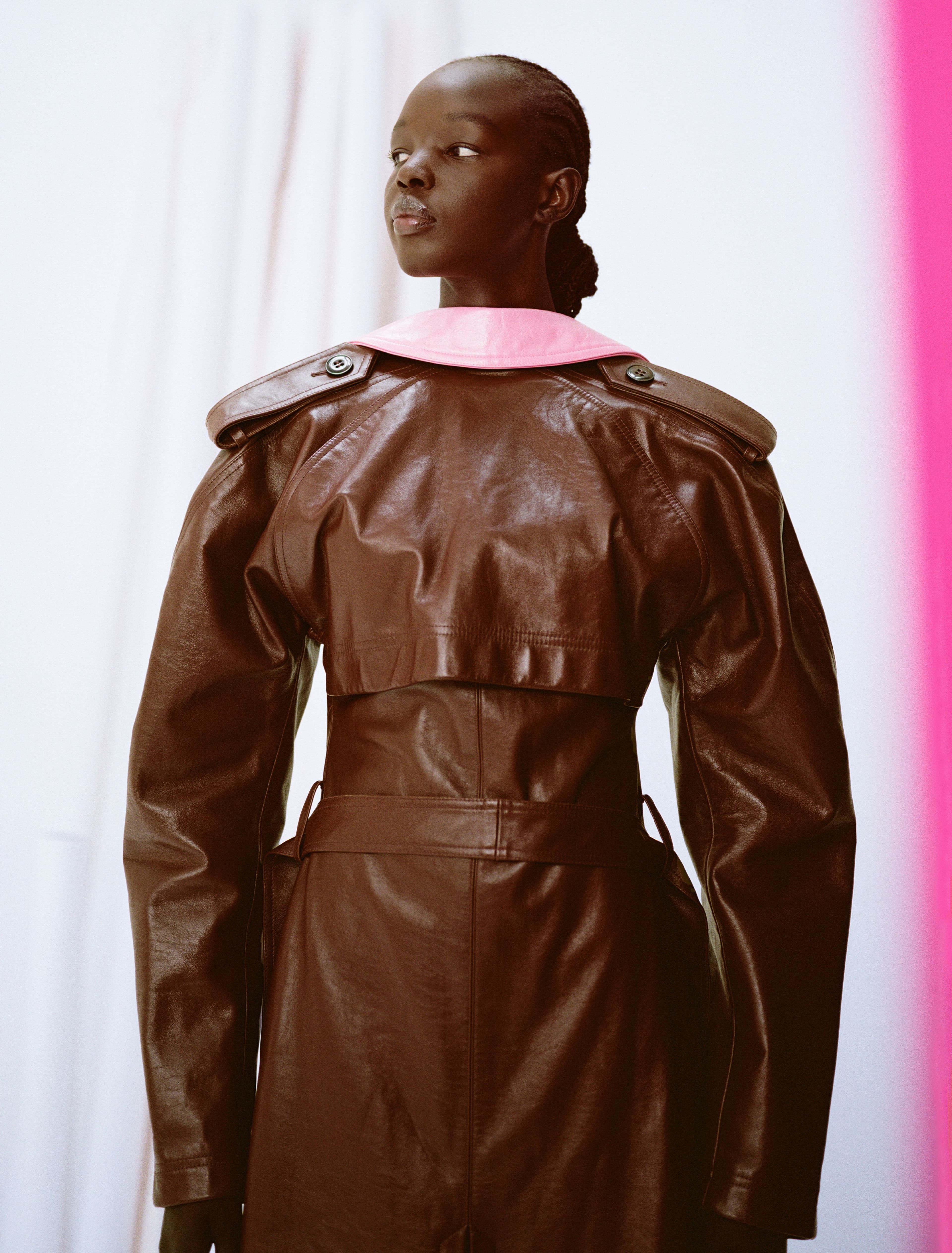
When the duo seeks to stretch across artforms with potential collaborators, their process reflects the same curiosity. Rather than chasing big-name partnerships, Aitouganov looks for exchanges that feel organic. “When we come across an artist that really inspires us, we think, Okay, we can try to achieve something like that, but it would be way cooler to really collaborate with them,” he notes. “I love sitting down with the artist and talking about how they would envision it through their eyes.” That philosophy led to a recent partnership with Make Up For Ever (Asha worked with the brand for a 2022 ad campaign), which approached them while rebranding around color. “They obviously love color like we do,” Aitouganov confides. “In the future, we’ll do some makeup with them. It’s exciting.”
Zomer’s visual world is as multicultural as its founders. Aitouganov was born in Tatarstan, a small republic in Russia rich in folkloric tradition, while Asha, who grew up in the Caribbean, brings an innate understanding of rhythm and color. Both spent considerable time in the Netherlands before launching their creative partnership in Paris, and their respective experiences create a kind of linguistic shorthand in the studio. “Subconsciously, all these different cultures influence us,” Aitouganov observes. “Our references overlap.” He sees traces of his heritage—Tatar prints, the exuberance of folk textiles—in conversation with Asha’s saturated Caribbean palette. That mix, he says, “is what makes Zomer.” Over time, critics have noticed a distinctly Dutch sensibility emerging as well, in the brand’s restrained use of color blocking and graphic composition. “People started saying we have a Dutch palette,” he laughs. “And I was like, Maybe you’re right.”
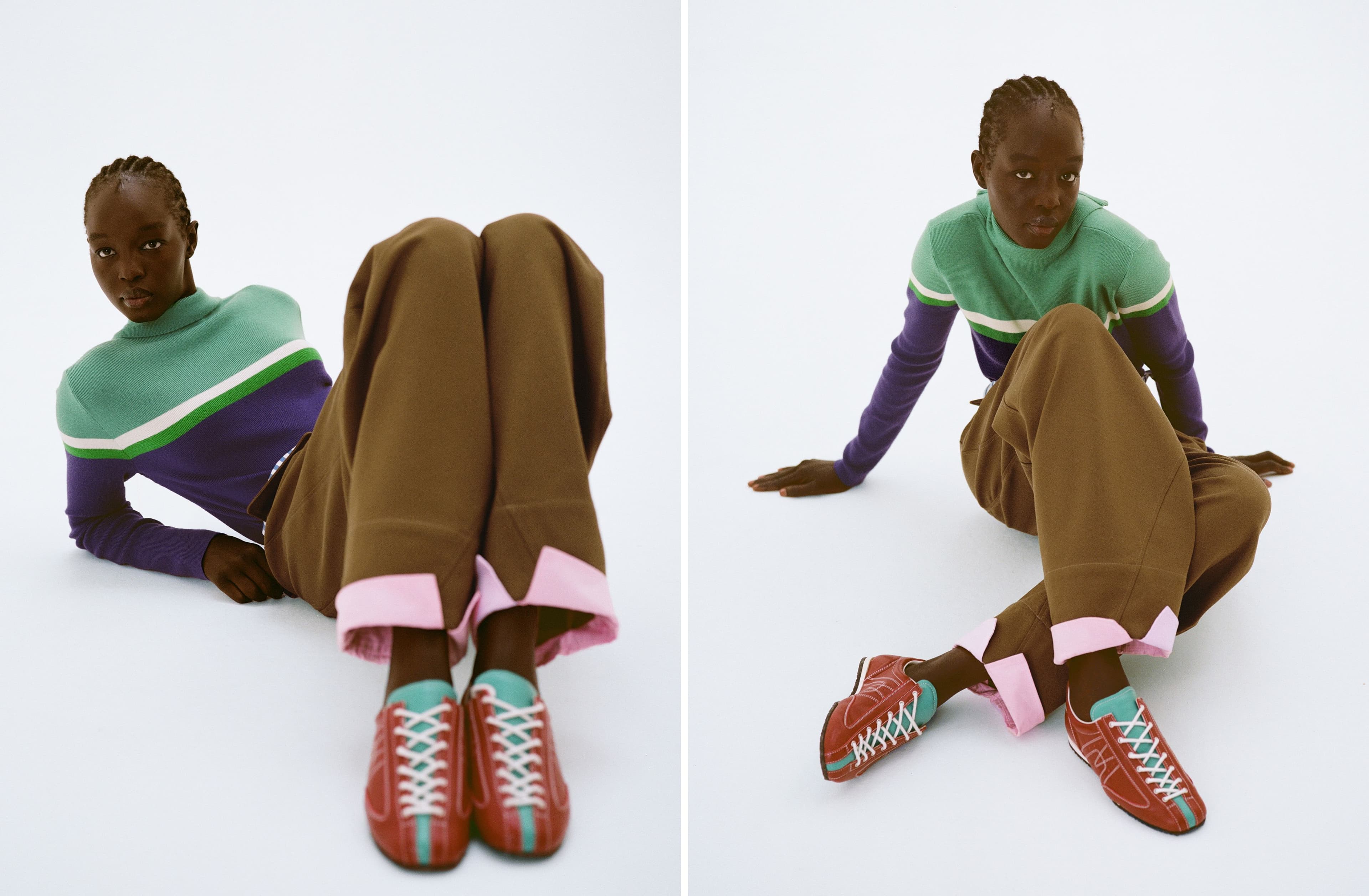
If the clothes capture Zomer’s playfulness, the shows crystallize it for viewers’ enjoyment. Their runways are joyful events—intimate, offbeat, and often surprising. Aitouganov describes a running list of ideas the team keeps for finales: moments meant to elicit a smile. “Sometimes it works, sometimes we need a plan B,” he says. “But people laugh, and that’s important to us.” He recalls one moment that stayed with him: after a show, a journalist rushed backstage, effusive and grinning. “She said, ‘It was like a vitamin shot. I needed this.’” For Aitouganov, that comment became a mission statement. “That’s always the feeling we want to achieve,” he remarks. “For the shows, and for the clothes—that you feel vibrant in it and seen.”
The road ahead for Zomer includes expansion, but on their terms. Menswear is a clear next step. “Me and Imruh are both men,” he reminds me, “so we’d love to have clothing that we could wear.” But entering a new market raises logistical questions. “It’s a bit of a headache,” he acknowledges. “We don’t have the budgets yet to fulfill such dreams, but it’s definitely on our list.” That kind of clear-eyed realism runs through everything Aitouganov says. There’s ambition but also a theme of restraint—purpose as a cornerstone rather than incessant growth. Zomer’s exuberant discipline feels like a rebellion against fashion’s addiction to speed. In an industry that prizes virality and expansion, the brand’s insistence on stability—and particularly its keenly curated culture of care—is borderline radical.
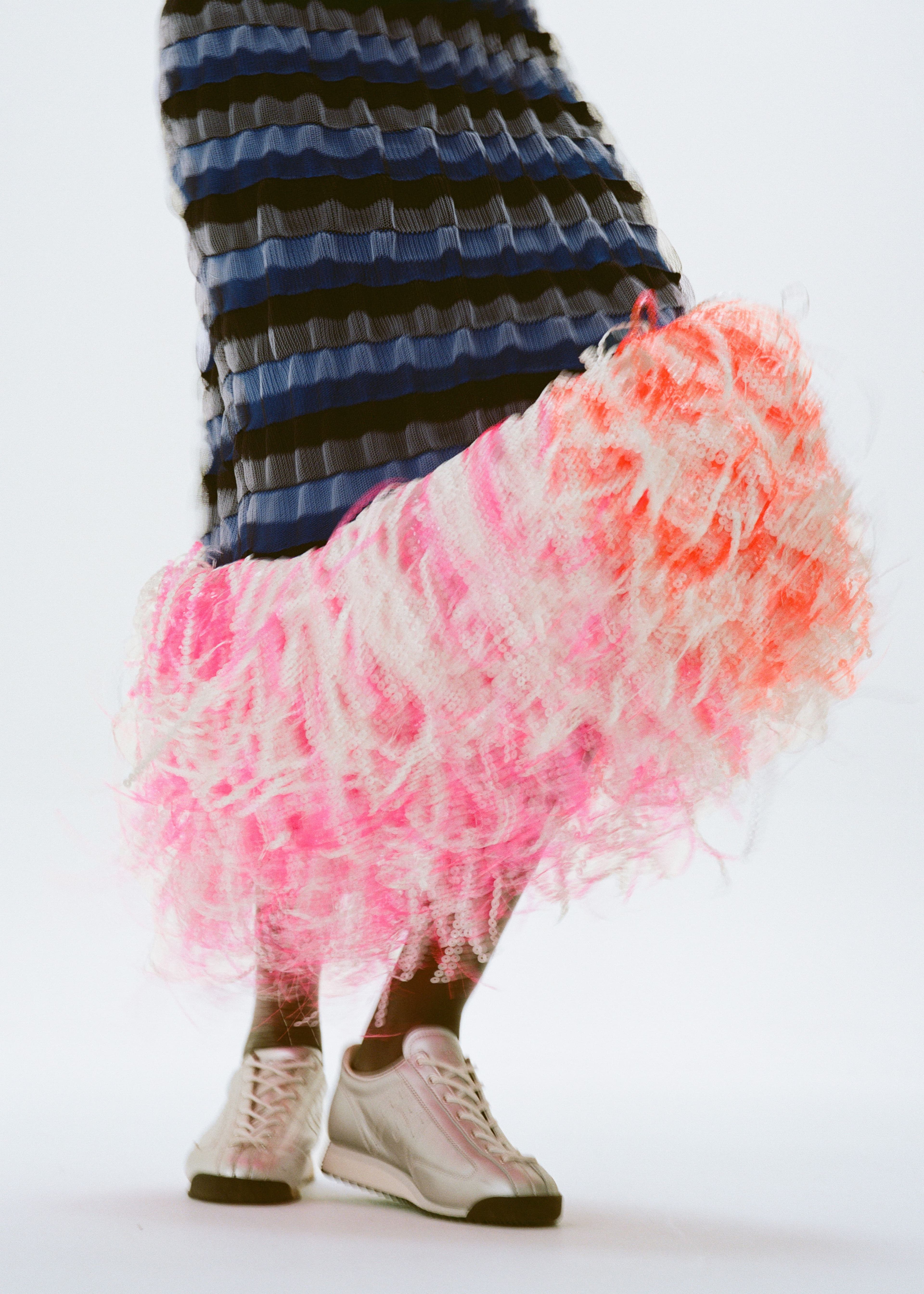
What makes Zomer compelling isn’t just its æsthetic—the candy-colored tailoring or architectural draping—but its ethos. The brand insists that fashion can be serious without being somber, that play can coexist with rigor. Its founders see color not as decoration but as energy, a kind of optimism you can wear. Aitouganov recalls a journalist calling a recent show a “vitamin shot,” perhaps the most fitting metaphor: a brief, radiant jolt that reminds you fashion can still make you feel something simple and good.
For a label barely two years old, Zomer is remarkably sure of its voice. Aitouganov and Asha are not seeking market dominance or to define an era. They’re instead constructing something sustainable, sincere, and alive—concocting clothes that, in Aitouganov’s own words, leave people “vibrant and seen.” In a world preoccupied with what’s next, Zomer is content to stay in the present, to savor the moment, to let summer last a little longer.
For more information, please visit zomerparis.com. Read this story and many more in print by ordering our tenth issue here.
As a nonprofit arts and culture publication dedicated to educating, inspiring, and uplifting creatives, Cero Magazine depends on your donations to create stories like these. Please support our work here.